Variational Autoencoders: The ELBO and the Reparameterization Trick
The VAE framework and its training objective
Generative modeling aims to learn the underlying data distribution
and generate new samples from it. Classical approaches include
Gaussian mixture models (Reynolds 2009), kernel
density estimation, and graphical models (Bayesian networks, Markov
random fields). These methods scale poorly to high-dimensional
data: Gaussian mixtures require exponentially many components,
kernel methods suffer from the curse of dimensionality, and
graphical-model inference is intractable for dense dependencies. Deep
learning changed the field by moving the modelling effort from the
density to the map. Classical methods place a tractable density
directly on
and then pay for that tractability in expressiveness. Neural methods
instead parameterize a map from a simple distribution to the data and
let the density be whatever that map induces, which removes the
component-count and bandwidth bottlenecks above at the price of an
objective that is no longer a plain likelihood. Every paradigm below is
a different answer to the question that price raises: what do you
optimize when you can no longer optimize the likelihood directly?
Variational Autoencoders
(Kingma
and Welling 2014) introduced amortized variational inference with
neural networks, enabling efficient approximate posterior inference
through the Evidence Lower Bound (ELBO).
Extensions include importance-weighted bounds
(Burda et al.
2016), disentangled representations
(Higgins et
al. 2017), and hierarchical architectures
(Vahdat and Kautz
2020). The VAE framework connects to classical variational Bayes
(Jordan et
al. 1999) and neural autoencoders (Hinton and Salakhutdinov
2006), combining the probabilistic principles of the former with
the representation-learning flexibility of the latter.
Generative Adversarial
Networks (Goodfellow et al. 2014)
frame generation as a game between generator and discriminator networks
through the adversarial game. Key
advances include stable training
techniques (Gulrajani et al. 2017), progressive growing (Karras et al.
2018), and style-based generation (Karras et al.
2019). The game-theoretic framing spread under the label
``adversarial'', but two different things travelled under that one word,
and they are separate. What transferred literally is the
discriminator as a learned loss: domain-adversarial training
(Ganin
et al. 2016) trains a domain classifier on the features and
reverses its gradient into the feature extractor, so the classifier
plays exactly the discriminator's role of supplying a loss that adapts
to whatever the encoder is currently getting wrong. What transferred
only in form is the saddle point: adversarial robustness (Madry et al.
2018) writes training as
,
which is a minimax problem, but its inner maximiser is a
projected-gradient attack on the input rather than a second network with
parameters of its own. So domain adaptation inherited the GAN mechanism
and robust training inherited the GAN shape, and conflating the two is
what makes the ``adversarial'' literature look more unified than it
is.
Normalizing Flows (Rezende and
Mohamed 2015) provide exact likelihood computation through
invertible transformations. Notable architectures include Real NVP (Dinh et al. 2017), MAF (Papamakarios et al. 2018),
Glow (Kingma and Dhariwal 2018), and Neural Spline Flows (Durkan et al.
2019). Flows generalize classical change-of-variables density
estimation by using deep neural networks as the transformation, with
careful design constraints to maintain invertibility and efficient
Jacobian computation.
Score-based models
(Song and Ermon
2020) learn the gradient of the log-density and generate via Langevin dynamics. The connection to diffusion
models (Ho et
al. 2020) established a unified framework through stochastic differential equations
(Song et al.
2021). Score-based generation builds on score matching (Hyvärinen
2005) and denoising autoencoders (Vincent et al. 2008), with
the continuous-time formulation drawing on results from stochastic
calculus (Anderson's reverse-time diffusion theorem from 1982).
Autoregressive models (PixelRNN (Oord, Kalchbrenner, and
Kavukcuoglu 2016), PixelCNN (Oord, Kalchbrenner, Vinyals,
et al. 2016), WaveNet (Oord, Dieleman, et al.
2016), GPT (Radford et al. 2019)) provide
a competing paradigm that factorizes the joint via the chain rule and
models each conditional with a deep neural network. For discrete data
and sequences, autoregressive models are often the natural choice; for
continuous high-dimensional data, they have been largely superseded by
diffusion models due to sampling speed.
Recent work has focused on unifying these paradigms through the
score SDE framework(Song et al. 2021), Flow
Matching(Lipman et al. 2023), and the
Schrödinger bridge perspective(De Bortoli et al. 2021).
The field increasingly views VAE/GAN/flow/diffusion as different
instantiations of a common transport-map framework, with architectural
and training-objective choices distinguishing them rather than
fundamental paradigm differences.
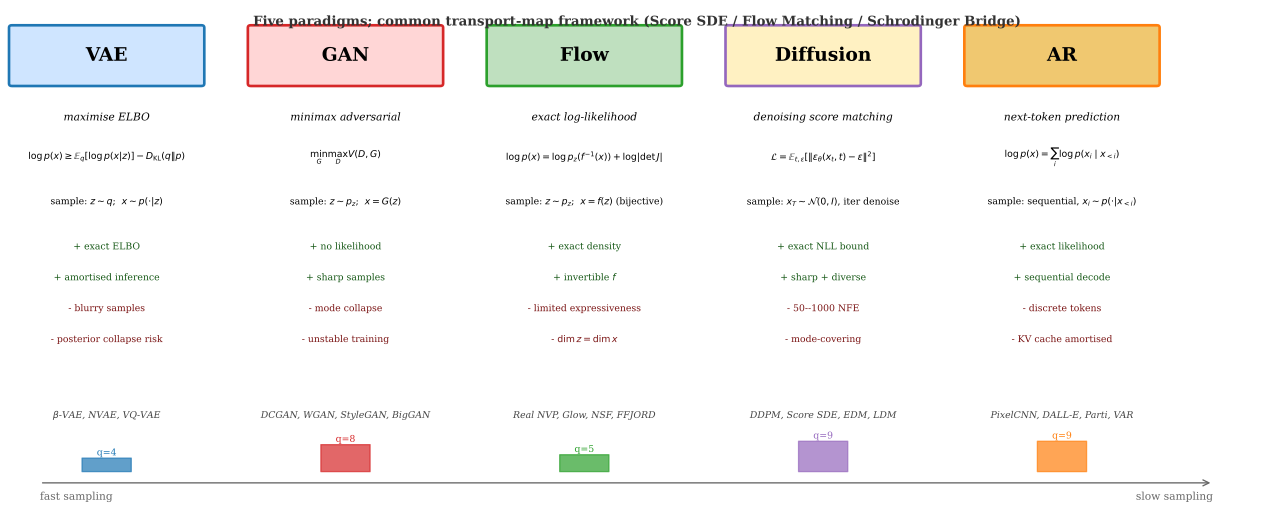
Taxonomy of deep generative models across five paradigms
(VAE, GAN, Flow, Diffusion, AR), each shown with its training objective,
headline equation, sampling procedure, two structural strengths (green
+) and two costs (red -), and representative architectures. The ribbon
at top names the modern unifying view: Score SDE, Flow Matching, and the
Schrodinger Bridge formulations cast all five as different
parameterisations of the same transport-map problem; what distinguishes
them is the choice of training objective and the constraint on the
parametric family rather than a fundamental paradigm difference.
Coloured bars at the bottom give a rough indicative-only quality ranking
on standard image benchmarks (illustrative; exact FID rankings depend on
dataset, resolution, and conditioning); diffusion and AR currently sit
at the top, GAN on aligned-portrait data remains competitive, flows lag
on images but lead on tabular density.
The five paradigms are the VAE, the GAN, the flow, the score-based model and the diffusion model, and each
is detailed in the sections that follow, with its core formulation, its
key extensions, its practical training considerations, its architectural
innovations, and its empirical results. Two readings run in parallel
throughout. The historical reading asks what problem each paradigm was
built to solve. The modern reading asks where each sits in the
transport-map framework, and that reading has a single organising claim:
every one of these models learns a map from a simple distribution to the
data, and what separates them is the divergence the objective minimises
plus the constraint the parametric family carries. The divergence is the
load-bearing choice. Forward KL is mode-covering, so VAEs, flows,
autoregressive models and diffusion cover modes and blur; reverse KL is
mode-seeking, so the non-saturating GAN sharpens and drops modes; JS
saturates when supports are disjoint, which is why the original GAN
objective stalls; the Wasserstein distance stays finite across disjoint
supports, which is why WGAN trains where JS does not. Each paradigm's
characteristic failure mode is a consequence of its divergence rather
than an accident of its architecture, and the information-theoretic
section closes the argument. Read every section below as an answer
to two questions: which divergence, and which constraint.
References
Burda, Yuri, Roger Grosse, and Ruslan Salakhutdinov. 2016.
"Importance WeightedAutoencoders."International Conference on
Learning Representations, November. https://doi.org/10.48550/arXiv.1509.00519.
De Bortoli, Valentin, James Thornton, Jeremy Heng, and Arnaud Doucet.
2021. "Diffusion Schrödinger Bridge with Applications to
Score-Based Generative Modeling."Advances in Neural
Information Processing Systems (NeurIPS). https://arxiv.org/abs/2106.01357.
Ganin, Yaroslav, Evgeniya Ustinova, Hana Ajakan, et al. 2016.
"Domain-AdversarialTraining of
NeuralNetworks."Journal of
Machine Learning Research 17 (59): 1-35. https://www.jmlr.org/papers/v17/15-239.html.
Goodfellow, Ian J., Jean Pouget-Abadie, Mehdi Mirza, et al. 2014.
"Generative AdversarialNetworks."Advances in Neural Information
Processing Systems, June. https://doi.org/10.48550/arXiv.1406.2661.
Gulrajani, Ishaan, Faruk Ahmed, Martin Arjovsky, Vincent Dumoulin, and
Aaron Courville. 2017. "Improved Training of
WassersteinGANs."Advances in
Neural Information Processing Systems, December. https://doi.org/10.48550/arXiv.1704.00028.
Higgins, Irina, Loic Matthey, Arka Pal, et al. 2017.
"Beta-VAE: LearningBasicVisualConcepts with a
ConstrainedVariationalFramework." February. https://openreview.net/forum?id=Sy2fzU9gl.
Hinton, Geoffrey E., and Ruslan R. Salakhutdinov. 2006. "Reducing
the Dimensionality of Data with Neural Networks."Science 313 (5786): 504-7.
Ho, Jonathan, Ajay Jain, and Pieter Abbeel. 2020. "Denoising
DiffusionProbabilisticModels."Advances in Neural Information
Processing Systems, December. https://doi.org/10.48550/arXiv.2006.11239.
Hyvärinen, Aapo. 2005. "Estimation of Non-Normalized Statistical
Models by Score Matching."Journal of Machine Learning
Research (JMLR) 6: 695-709.
Jordan, Michael I., Zoubin Ghahramani, Tommi S. Jaakkola, and Lawrence
K. Saul. 1999. "An Introduction to Variational Methods for
Graphical Models."Machine Learning 37 (2): 183-233.
Karras, Tero, Timo Aila, Samuli Laine, and Jaakko Lehtinen. 2018.
"Progressive Growing of GANs for
ImprovedQuality, Stability, and
Variation."International Conference on Learning
Representations, February. https://doi.org/10.48550/arXiv.1710.10196.
Karras, Tero, Samuli Laine, and Timo Aila. 2019. "A
Style-BasedGeneratorArchitecture for GenerativeAdversarialNetworks."IEEE/CVF
Conference on Computer Vision and Pattern Recognition (CVPR),
March. https://doi.org/10.48550/arXiv.1812.04948.
Kingma, Diederik P., and Max Welling. 2014.
"Auto-EncodingVariationalBayes."International Conference on Learning
Representations, December. https://doi.org/10.48550/arXiv.1312.6114.
Lipman, Yaron, Ricky T. Q. Chen, Heli Ben-Hamu, Maximilian Nickel, and
Matt Le. 2023. Flow Matching for
GenerativeModeling. arXiv. https://doi.org/10.48550/arXiv.2210.02747.
Madry, Aleksander, Aleksandar Makelov, Ludwig Schmidt, Dimitris Tsipras,
and Adrian Vladu. 2018. "Towards DeepLearningModelsResistant to
AdversarialAttacks."International
Conference on LearningRepresentations (ICLR). https://openreview.net/forum?id=rJzIBfZAb.
Oord, Aäron van den, Sander Dieleman, Heiga Zen, et al. 2016.
WaveNet: A Generative Model for Raw Audio. https://arxiv.org/abs/1609.03499.
Oord, Aäron van den, Nal Kalchbrenner, and Koray Kavukcuoglu. 2016.
"Pixel Recurrent Neural Networks."International
Conference on Machine Learning (ICML). https://arxiv.org/abs/1601.06759.
Oord, Aäron van den, Nal Kalchbrenner, Oriol Vinyals, Lasse Espeholt,
Alex Graves, and Koray Kavukcuoglu. 2016. "Conditional Image
Generation with PixelCNN Decoders."Advances in
Neural Information Processing Systems (NeurIPS). https://arxiv.org/abs/1606.05328.
Song, Yang, Jascha Sohl-Dickstein, Diederik P. Kingma, Abhishek Kumar,
Stefano Ermon, and Ben Poole. 2021. "Score-BasedGenerativeModeling Through
StochasticDifferentialEquations."International Conference on Learning
Representations, February. https://doi.org/10.48550/arXiv.2011.13456.
Vahdat, Arash, and Jan Kautz. 2020. "NVAE:
ADeepHierarchicalVariationalAutoencoder."Advances
in Neural Information Processing Systems, January. https://doi.org/10.48550/arXiv.2007.03898.
Vincent, Pascal, Hugo Larochelle, Yoshua Bengio, and Pierre-Antoine
Manzagol. 2008. "Extracting and Composing Robust Features with
Denoising Autoencoders."International Conference on Machine
Learning (ICML).