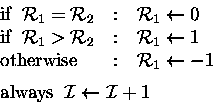
,
,  and the instruction pointer
  , the only three
internals of the process, carry out the functions of the
data, address, condition and the instruction
registers of a Von Neumann machine.
, the only three
internals of the process, carry out the functions of the
data, address, condition and the instruction
registers of a Von Neumann machine.
Our process (lets name it from now on as the HW-1 machine) works on a sequence of integers each of which are in the range [-127,+127]. Here is an example for such a sequence:
Furthermore, the HW-1 machine has three registers which we name as , an .Each one of and can hold an integer in the range [-127,+127]. Storing
negative
values into is not allowed, it can hold any integer in the range [0,+255]
(though in your exercises the values of will be about 10-30, at most).
The square bracket notation applies for these registers as well. Namely ![$[{\cal R}_1]$](img7.gif) means the
content of the th element in the sequence. So, for instance, if has at
any moment the value 3 and if at that moment the 3rd sequence element is 33
(as it is in the example above) then refers that 33.
means the
content of the th element in the sequence. So, for instance, if has at
any moment the value 3 and if at that moment the 3rd sequence element is 33
(as it is in the example above) then refers that 33.
The interesting point is that the values in the sequence as well as the values in the registers can be changed freely to new values. When this is the case the former value is erased and the new value is substituted in that place. We will call this action an assignment and will represent it by the following notation:
 new value
 |
is set to the value 5 |
 |
is set to the same value is holding now.
(Attention: This does not mean that any following changes on will effect the
value stored in ) |
![${\cal R}_2\leftarrow [2] $](img11.gif) |
is set to the 2nd value in the sequence. |
![$[0] \leftarrow {\cal R}_1$](img12.gif) |
The 0th (zeroth) value in the sequence is changed to be the
same value that is in . |
 |
The content of is incremented by one. |
Given a sequence, HW-1 starts with the register having 0 (zero)
value and
the other two registers having arbitrary values. It works by
repeatatively going through a process cycle until a halt instruction is
executed. A process cycle is:
![$[{\cal I}]$](img14.gif) as an instruction.
as an instruction.
The HW-1 accepts 17 instructions which are explained below. Instructions are recognized as integers [0,1,...,16].

 with the next number in the sequence.
![\begin{displaymath}
{\cal R}_1\leftarrow [{\cal I}+1] \;,\quad {\cal I}\leftarrow {\cal I}+ 2 \end{displaymath}](img17.gif)
 with the next number in the
sequence.
with the next number in the
sequence.
![\begin{displaymath}
{\cal R}_2\leftarrow [{\cal I}+1] \;,\quad {\cal I}\leftarrow {\cal I}+ 2 \end{displaymath}](img19.gif)
 with the sequence element which is at
the position given as the next number in the sequence.
with the sequence element which is at
the position given as the next number in the sequence.
![\begin{displaymath}
{\cal R}_1\leftarrow [[{\cal I}+1]] \;,\quad {\cal I}\leftarrow {\cal I}+ 2 \end{displaymath}](img21.gif)
 with the sequence element which is at
the position given as the next number in the sequence.
with the sequence element which is at
the position given as the next number in the sequence.
![\begin{displaymath}
{\cal R}_2\leftarrow [[{\cal I}+1]] \;,\quad {\cal I}\leftarrow {\cal I}+ 2 \end{displaymath}](img23.gif)
 with the content of .

 with the sequence element which is at the position
.
with the sequence element which is at the position
.
![\begin{displaymath}
{\cal R}_1\leftarrow [{\cal R}_2] \;,\quad {\cal I}\leftarrow {\cal I}+ 1 \end{displaymath}](img27.gif)
 to be the content of .
![\begin{displaymath}[{\cal R}_1]
\leftarrow {\cal R}_2\;,\quad {\cal I}\leftarrow {\cal I}+ 1 \end{displaymath}](img29.gif)
 .
.
![\begin{displaymath}[[{\cal I}+1]
]\leftarrow {\cal R}_1\;,\quad {\cal I}\leftarrow {\cal I}+ 2 \end{displaymath}](img31.gif)

![\begin{displaymath}
{\cal I}\leftarrow [{\cal I}+ 1] \end{displaymath}](img33.gif)
 contains zero continue with the sequence element following the
next one as
the next instruction to be performed, otherwise act like the
instruction 9.
contains zero continue with the sequence element following the
next one as
the next instruction to be performed, otherwise act like the
instruction 9.
![\begin{displaymath}
\begin{array}
{l@{\quad:\quad}l}
\mbox{if}\;\;{\cal R}_1=0 ...
...box{otherwise} & {\cal I}\leftarrow [{\cal I}+1]
\end{array} \end{displaymath}](img35.gif)
 by the content of .

 by the content of .

 by the content of .

 by the content of (integer division).

 .
.

 with the content of .