
 |
 |
 |
![\framebox [7mm]{\rule[-1.5mm]{0mm}{5mm}{?}}](img49.gif) |
|
![\framebox [7mm]{\rule[-1.5mm]{0mm}{5mm}{0}}](img50.gif) |
contains , the th (zeroth) element of the sequence, ![$[{\cal I}]$](img14.gif) is fetched. This will be our current instruction. Looking at the sequence you
may realize that this element is 9. Look at the definition of the
instruction 9 (given on the previous page), you will see that the action of the
instruction 9 is:
is fetched. This will be our current instruction. Looking at the sequence you
may realize that this element is 9. Look at the definition of the
instruction 9 (given on the previous page), you will see that the action of the
instruction 9 is:
![\begin{displaymath}
{\cal I}\leftarrow [{\cal I}+ 1] \end{displaymath}](img33.gif)
 is 1 and therefore
 ![$[{\cal I}+ 1]$](img52.gif) is simply [1], in other words
the 1st element of the sequence. That is 6. So the value in is changed by the assignment operation to be 6. And now the registers are:
is simply [1], in other words
the 1st element of the sequence. That is 6. So the value in is changed by the assignment operation to be 6. And now the registers are: |
|
|
|
|
![\framebox [7mm]{\rule[-1.5mm]{0mm}{5mm}{6}}](img53.gif) |
contains 6. The machine fetches [6] which is 3.
Instruction 3 is defined as:
![\begin{displaymath}
{\cal R}_1\leftarrow [[{\cal I}+1]] \;,\quad {\cal I}\leftarrow {\cal I}+ 2 \end{displaymath}](img21.gif)
to be ![$[[{\cal I}+1]]$](img54.gif) .
Now do not panic! was holding a value of 6 therefore the inner brackets
are nothing else but
.
Now do not panic! was holding a value of 6 therefore the inner brackets
are nothing else but
![\begin{displaymath}[[\;\underbrace{{\cal I}+1}_{[6+1]
}\;]]
\qquad
\mbox{which is} \quad
[[7]] \end{displaymath}](img55.gif)
![${\cal R}_1\leftarrow [[{\cal I}+1]]$](img56.gif) this value found on the right hand
side of the assignment, namely the 12, will be stored into .
The second assignment increments the value of by 2. Thus is now
6+2 which is 8. At the end of this cycle the register contents are:
this value found on the right hand
side of the assignment, namely the 12, will be stored into .
The second assignment increments the value of by 2. Thus is now
6+2 which is 8. At the end of this cycle the register contents are:
|
|
|
![\framebox [7mm]{\rule[-1.5mm]{0mm}{5mm}{12}}](img57.gif) |
|
![\framebox [7mm]{\rule[-1.5mm]{0mm}{5mm}{8}}](img58.gif) |
is containing 8 we fetch [8] as the instruction of this cycle.
The 8th element of the sequence is 4. The instruction 4 is defined
similar to the instruction 3 but now it is the register that receives
the value and not . Going through a very similar argumentation
that we did for cycle 2,
we conclude that will be assigned the value [3] which is 27.
Following this assignment,
will be incremented by 2. That is how the registers look
like:
|
|
|
|
![\framebox [7mm]{\rule[-1.5mm]{0mm}{5mm}{27}}](img59.gif) |
![\framebox [7mm]{\rule[-1.5mm]{0mm}{5mm}{10}}](img60.gif) |
to the content of and assigns the sum to (Please go and check
the definition of instruction 11). So the following operation is performed:
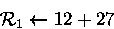
is assigned a value of 39. Due to the definition of instruction
11, the register is incremented by 1. At the end of this cycle the
registers read as:
|
|
|
![\framebox [7mm]{\rule[-1.5mm]{0mm}{5mm}{39}}](img62.gif) |
|
![\framebox [7mm]{\rule[-1.5mm]{0mm}{5mm}{11}}](img63.gif) |
is 4 which means that
is assigned the value [4]. From the sequence we get that this value
is 39. So  . By the definition, is incremented by 2.
Now the registers are:
. By the definition, is incremented by 2.
Now the registers are:
|
|
|
|
|
![\framebox [7mm]{\rule[-1.5mm]{0mm}{5mm}{13}}](img65.gif) |
and . If they are equal is changed to
, if the value of is greater than the value of then is
changed to 1. If it is the third possibility, which is the only one left,
namely the case where the value of is lesser than the value of then
is changed to -1. In all cases is incremented by one.
Following this definition and looking at the contents of the registers
we can conclude that HW-1 will change to since both and have the value 39, hence they are equal. The registers are:
|
|
|
|
|
![\framebox [7mm]{\rule[-1.5mm]{0mm}{5mm}{14}}](img66.gif) |
contains a non zero value then the instruction of the
next cycle will be fetched from the sequence position that given at . In our case the register indeed contains a . So the jump will not take
place and the register will simply be incremented by 2. (If the
jump would have taken place then would be set to 20
and this would be the
position in the sequence from which the instruction for cycle 8
would be fetched)
So the registers are
|
|
|
|
|
![\framebox [7mm]{\rule[-1.5mm]{0mm}{5mm}{16}}](img67.gif) |
with . In our case this is ![${\cal R}_2\leftarrow [17]$](img68.gif) and will result in
and will result in  . For an instruction 2, will be incremented by 2. At the end of this
cycle we have in the registers
. For an instruction 2, will be incremented by 2. At the end of this
cycle we have in the registers
|
|
|
|
![\framebox [7mm]{\rule[-1.5mm]{0mm}{5mm}{1}}](img70.gif) |
![\framebox [7mm]{\rule[-1.5mm]{0mm}{5mm}{18}}](img71.gif) |
will be set to and that is 22.
The registers are
|
|
|
|
|
![\framebox [7mm]{\rule[-1.5mm]{0mm}{5mm}{22}}](img72.gif) |
with . For our case this is 5. Instruction 1 increments
by 2. Now we have the registers as
|
|
|
![\framebox [7mm]{\rule[-1.5mm]{0mm}{5mm}{5}}](img73.gif) |
|
![\framebox [7mm]{\rule[-1.5mm]{0mm}{5mm}{24}}](img74.gif) |
![\begin{displaymath}[{\cal R}_1]
\leftarrow{\cal R}_2\end{displaymath}](img75.gif)
by one.
Due to this definition a ![$[5] \leftarrow 1$](img76.gif) is carried out. And for the first
time we have changed a value in the sequence. Now the 5th element is no more
99 but 1. This was the claimed action of the HW-1 machine with
this example sequence. After a following incrementation of the registers are:
is carried out. And for the first
time we have changed a value in the sequence. Now the 5th element is no more
99 but 1. This was the claimed action of the HW-1 machine with
this example sequence. After a following incrementation of the registers are:
|
|
|
|
|
![\framebox [7mm]{\rule[-1.5mm]{0mm}{5mm}{25}}](img77.gif) |

|
|
|
|
|
|
``The name of the song is called `Haddocks' Eyes.'''
. Then name really is `The Aged Aged Man.'''
``Oh, that's the name of the song, is it?'' Alice said trying to feel interested.
``No, you don't understand,'' the Knight said, looking a little vexed.
``That's what the name is called
``Then I ought to have said `That's what the song is called'?'' Alice corrected herself.
``No, you oughtn't: that's quite another thing! The song is called `Ways and Means': but that's only what it's called, you know!''
``Well, what is the song, then?'' said Alice, who was by this time completely bewildered.
``I was comming to that,'' the Knight said. ``The song really is `A-sitting On A Gate': and the tune's my own invention.''-Lewis Carroll, THROUGH THE LOOKING GLASS